
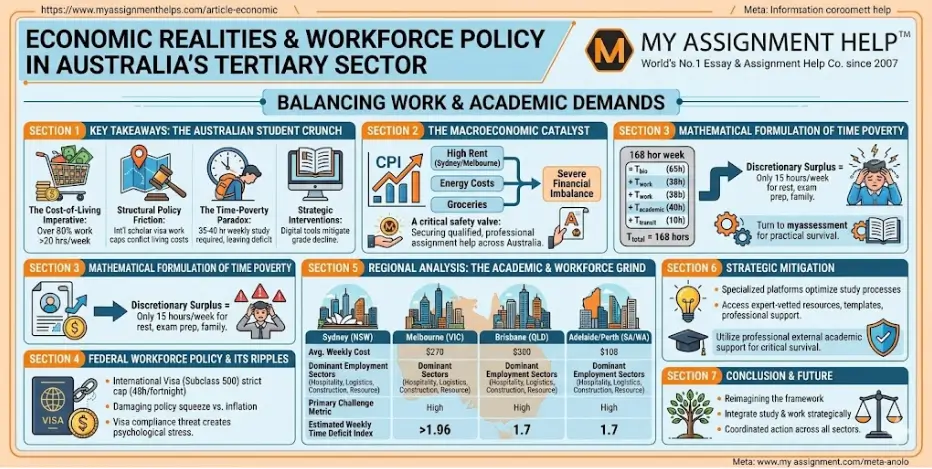
The Economic Realities of the Modern Australian Student: Balancing Workforce Policy and Academic Demands

Section 1: Introduction: The Dual-Identity Paradigm
The contemporary Australian higher education sector is undergoing a profound structural metamorphosis. Historically, the pursuit of an undergraduate or postgraduate qualification across domestic campuses was viewed as a primary, full-time commitment. Employment during semesters was treated as an auxiliary mechanism, designed to provide modest discretionary income rather than fundamental livelihood security. However, structural macroeconomic shifts over the past half-decade have permanently dismantled this traditional archetype.
Today, the typical individual navigating the lecture theatres of Sydney, Melbourne, Brisbane, and Perth is no longer merely a student who occasionally works. Instead, they operate as a deeply entrenched worker who concurrently manages intensive, high-stakes academic schedules. This systemic shift is driven by a complex interplay of domestic inflation, severe housing market constraints, and evolving federal workforce frameworks. As a consequence, the tension between maintaining robust academic integrity and satisfying the uncompromising financial demands of daily life has reached an unprecedented zenith. This comprehensive inquiry analyzes the precise macroeconomic factors underpinning this crisis, evaluates the localized policy environments, and investigates how the modern scholastic collective leverages external operational frameworks to survive the structural squeeze.
Section 2: The Macroeconomic Catalyst: Inflation, Rent, and the Cost of Living
To fully comprehend the contemporary crisis within the Australian tertiary educational landscape, one must look closely at current domestic macroeconomic indicators. The consumer price index (CPI) within the Commonwealth has demonstrated sustained stickiness over recent fiscal periods, with essential expenditure categories—specifically domestic housing, energy, and groceries—outpacing wage expansion inside traditional student employment sectors, such as retail and hospitality. According to data compiled by the Australian Bureau of Statistics (ABS), national rental vacancy rates have hovered near historic lows of less than 1.5%, triggering unprecedented competitive rent hikes across major urban university hubs.
For individuals residing within close proximity to major institutions, weekly rental costs frequently absorb upwards of 60% of total net household income. This severe financial imbalance effectively nullifies standard statutory assistance, including Youth Allowance or Austudy allocations, which continuously lag behind the real-world operational costs of metropolitan living. Consequently, financial self-sufficiency is no longer achieved through casual weekend shifts. It demands an exhaustive integration into the modern casualized labor market. Scholars are compelled to continuously trade precious cognitive capital for immediate economic liquid returns, a reality that introduces severe, downstream academic complications.
Within this unforgiving financial landscape, the operational pressures facing the student-worker demographic are profound. For a growing percentage of the domestic population, securing qualified, professional assignment help across Australia serves as an essential safety valve. This specialized intervention allows individuals to satisfy strict, complex grading rubrics while simultaneously keeping their vital hospitality or logistics shifts, ensuring they do not drop below the national poverty baseline.
Section 3: The Mathematical Formulation of Time Poverty
The crisis can be mathematically modeled using a deterministic time-allocation framework. Let the total weekly asset pool of available time be represented as T_{total} = 168 hours. We can define the essential biological and academic allocations using a baseline structural equation:
T_{total} = T_{bio} + T_{work} + T_{academic} + T_{transit} + \Delta
Where T_{bio} represents the non-negotiable hours required for physiological maintenance (sleep, meal preparation, hygiene), universally estimated at approximately 65 hours per week. T_{transit} accounts for multi-modal travel between regional residences, employment zones, and physical campuses, averaging 10 hours weekly within major urban sprawls. The standard academic expectation for a full-time study load (typically four active units) demands an investment of T_{academic} = 40 hours weekly, split between formal contact hours and self-directed research. This yields a baseline equation before employment variables are introduced:
168 = 65 + T_{work} + 40 + 10 + \Delta \rightarrow T_{work} + \Delta = 53
When an individual must execute T_{work} = 38 hours of commercial labor to meet real-world urban living costs, the remaining discretionary surplus variable (\Delta) shrinks down to a razor-thin 15 hours per week. This tiny remnant must absorb all family obligations, unexpected health issues, mental rest, and targeted examination preparation. Any sudden escalation in operational work demands or a tightening of institutional assignment schedules inevitably pushes the entire system into a negative deficit, leading to immediate systemic breakdown.
Section 4: Federal Workforce Policies and Their Systemic Ripples
The friction between education and survival is further complicated by shifting federal workforce legislative policies. For the international cohort residing within Australia under Subclass 500 visas, work hour flexibilities have undergone significant structural revisions. The post-pandemic unlimited work rights were replaced by a strict cap, currently calibrated at 48 hours per fortnight. While implemented by the Department of Home Affairs to protect educational focus, the economic timing of this restriction has placed immense strain on foreign scholars.
When global inflation reduces the real value of foreign financial support, international scholars are caught in a damaging policy squeeze. They face strict legislative caps on earning potential right when domestic consumer costs are rising rapidly. This mismatch forces many into highly vulnerable positions, trying to balance restricted cash flows against uncompromising institutional fees. The constant threat of losing visa compliance due to financial shortfalls creates an atmosphere of ongoing psychological stress, which directly harms their overall academic performance.
The impact of this policy friction is clearly visible across diverse academic fields. Scholars enrolled in high-intensity professional programs—such as Bachelor of Nursing tracks, Juris Doctor law degrees, or complex Engineering certifications—face a double burden. These courses require hundreds of hours of unpaid, mandatory clinical or industrial placements, which completely disrupt regular employment schedules. When an intense placement cycle conflicts directly with major semester deadlines, many find it physically impossible to keep up. In these critical moments, turning to an established subject-matter expert to help do my assessment becomes a practical survival strategy. Outsourcing a complex literature review or a technical data analysis project allows them to complete their required on-site professional training hours without failing their academic units.
Section 5: Comparative Regional Analysis of the Academic and Workforce Grind
The operational experience of balancing these demands is not uniform across the continent. Different geographic locations present unique challenges based on local real estate pressures and dominant industry profiles.
| Institutional Metro Zone | Avg. Weekly Cost of Living (AUD) | Dominant Student Employment Sectors | Primary Academic Challenge Metric | Estimated Weekly Time Deficit Index |
| Sydney (NSW Hub) | 680 – 750 | Premium Hospitality, Corporate Retail, Gig Logistics | Extreme rental stress; long commute times from outer western suburbs. | High (-18 Hours) |
| Melbourne (VIC Hub) | 620 – 690 | Arts/Culture Events, Hospitality, Specialized Tuition | Unpredictable casual shift rostering; high institutional fees. | Elevated (-14 Hours) |
| Brisbane (QLD Hub) | 540 – 610 | Tourism Services, Construction Support, Aged Care | Rapidly rising housing costs; intense physical exhaustion from shifts. | Moderate (-10 Hours) |
| Adelaide / Perth | 480 – 550 | Regional Resource Sectors, Local Care Networks | Public transport gaps; limited off-peak casual work options. | Manageable (-6 Hours) |
Section 6: The Psychological Cost and Evolving Institutional Responses
Beyond the measurable metrics of time and money lies a more concerning issue: the deep psychological strain on the student population. The ongoing effort needed to balance high-intensity work with strict academic standards can lead to chronic cognitive fatigue and burnout. Mental health services across major universities report record-breaking demand, with anxiety, sleep deprivation, and depression cited as widespread issues. When a person is constantly worrying about immediate financial survival, their capacity for deep learning decreases significantly, undermining the core educational goals of higher education.
Concurrently, university administrations find themselves in a challenging position. While they strive to maintain high academic standards, their internal metrics show that traditional, rigid evaluation systems are causing increased drop-out rates. As a result, many institutions are moving toward more flexible models, incorporating hybrid learning options, recorded lectures, and extended assignment windows. However, these changes often act as temporary fixes rather than long-term solutions, failing to address the underlying financial realities that drive the crisis.
Section 7: Strategic Mitigation: Navigating the Systemic Squeeze
As long-term policy adjustments remain slow, students are taking matters into their own hands, adopting practical strategies to survive this challenging environment. This has led to a major shift toward digital learning tools and targeted academic support. Rather than spending valuable hours trying to decipher confusing administrative guidelines or complex technical requirements alone, scholars are increasingly using specialized platforms to optimize their study processes.
Leveraging specialized educational support allows individuals to shift from a state of constant panic to targeted, structured learning. By accessing expert-vetted resource libraries, step-by-step analytical templates, and professional editing support, individuals can gain a clear understanding of complex topics in a fraction of the time. This strategic balance protects their limited time, helping them maintain solid academic performance while securing the financial income needed to survive in modern Australia.
Section 8: Conclusion: Reimagining the Tertiary Framework
The economic realities facing modern scholars across Australia require a fundamental shift in how we understand higher education. The old model of a student dedicated entirely to academics is no longer viable in our major metropolitan centers. When inflation, high rent, and rigid workforce policies collide, work and study must be integrated strategically rather than treated as opposing forces.
Resolving this systemic tension requires coordinated action across multiple sectors. It demands progressive federal support programs, innovative university structures that respect student time, and a broader social understanding of the student-worker reality. Until these long-term structural changes occur, utilizing professional external academic support remains a critical tool for those striving to achieve both professional success and financial stability.
See also: Reliable Online Infrastructure 514011092 for Stability
Frequently Asked Questions (FAQ)
How do current cost-of-living increases affect students in Australia?
Persistent inflation and high rental costs mean students often have to work over 20 hours a week, leaving a significant time deficit for lectures, research, and exam preparation.
What are the current federal work limits for international visa holders?
International student visa holders face a statutory work cap of 48 hours per fortnight during teaching periods, creating financial challenges when living costs exceed this earning potential.
Why do professional courses create additional financial challenges?
Fields like Nursing and Engineering require extensive, unpaid professional placements, making it difficult to maintain steady employment income while keeping up with coursework.
How can student-workers manage their schedules without burning out?
Many successful individuals use hybrid study schedules, structured time-management apps, and external academic support platforms to handle complex coursework efficiently.
Author Bio
Kara Betty is a principal education researcher and lead content strategist at MyAssignmentHelp, specializing in macroeconomic trends within the tertiary sector across the Asia-Pacific region. With over a decade of experience analyzing educational policy changes, student welfare metrics, and academic integrity frameworks, their data-driven insights help institutions and individuals navigate the complexities of modern higher education.
Data Sources & References
- Australian Bureau of Statistics (ABS) – Consumer Price Index and Rental Market Reports.
- Department of Home Affairs – International Student Visa (Subclass 500) Workforce Regulations.
- Universities Australia – Annual Student Finances Survey and Cost of Living Impact Assessments.
- MyAssignmentHelp Internal Data Repository – Trends in Academic Support Requirements across Australian Metropolitan Areas.